Douglas B-18 Bolo
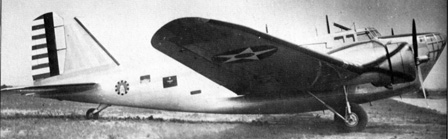
Developed from the DC-2 civil transport, the Douglas DB-1 was designed in 1934 as a replacement for the USAAC's standard bomber, the B-10. The DB-1 was the losing contender in the USAAC contest, which was won by the Boeing B-17. Despite this, the DB-1 entered production as the B-18, with most of the USAAC's bomber squadrons being equipped by B-18s or B-18A's in 1940. The majority of the 33 B-18A's stationed with the USAAC in Hawaii in 1941 were destroyed in the Japanese attack on Pearl Harbor. When the B-1 8 was replaced in first-line service by the B-17 in 1942, some 122 B-18s were equipped magnetic anomaly detection (MAD) equipment for deployment in the Caribbean on anti-submarine patrol. Some B-18s were used for transport duty, with a portion of these designated C-58s.
For more data on this aircraft, click
here
for Joe Baugher's webpage.
USAF archives on this aircraft, click
here.
Additional information on this aircraft
can be found at Wikipedia
here.
(updated February 2009)
Douglas B-18 Bolo
Type:		medium bomber and ASW aircraft
Crew:		6
Armament: 	three 0.30 inch machine guns
		up to 6,500 lbs. of bombs

Specifications:
	Length:        	57' 10" (17.63 m)
	Height:        	15' 2" (4.62 m)
	Wingspan:      	89' 6" (27.28 m)
	Wing area:	965 sq. ft (89.65 sq. m)
	Empty Weight:  	16,321 lb (7403 kg)
	Max Weight: 	27,673 lb (12,552 kg) max at takeoff

Propulsion:
	No. of Engines:	2
	Powerplant:    	Wright R-1820-53 Cyclone 9 radial
	Horsepower:	1000 hp

Performance:
	Range:		1200 miles (1931 km)
	Cruise Speed:   167 mph ( 269 km/h)
	Max Speed:      215 mph ( 346 km/h) at 10000 ft
	Ceiling:       	23,900 ft (7285 m)
If this page does not have a navigational frame on the left, click HERE to see the rest of the website.